Existing building to transform
LOD 300 model of the existing building, execution project overlaid. Shared reference between architect, engineering office, contractor. Avoids interpretation gaps.
LOD 200 to 400 digital model produced from a laser-scanner point cloud. Revit, ArchiCAD, IFC 4.0 compatible. Built-in BIM Manager validation.
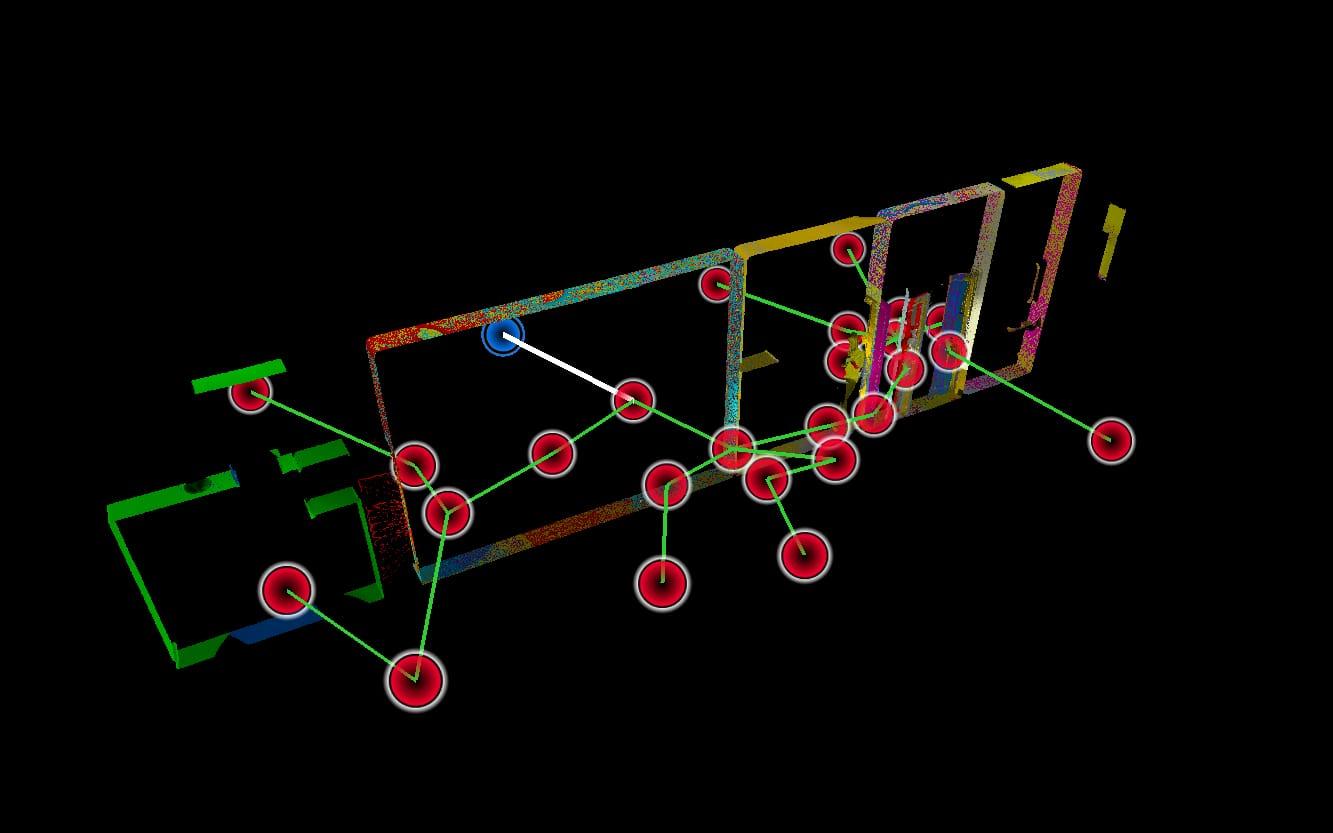
Scan-to-BIM, or Building Information Modelling from scan, is the process that transforms a 3D point cloud (from a laser scanner or photogrammetry) into an exploitable digital model — Revit, ArchiCAD, or open IFC 4.0. This model becomes the digital reference for the existing building, exploitable for renovation, maintenance operations, energy audits or long-term archiving.
ARPEO delivers BIM models at LOD 200, 300 or 400, depending on the end use defined with the client. LOD 200 (simplified envelope) is enough for a feasibility study or asset management. LOD 300 (detailed components) is required for heavy renovation, a financing plan or works monitoring. LOD 400 (manufacturing, identified manufacturers) targets prefabrication, industrial BIM-CIM or heritage archiving.
Our workflow: field scan (Leica BLK360 G2) → Cyclone REGISTER 360 registration → import into Revit with Lambert-93 georeferencing → component-based modeling with parametric families → Solibri IFC audit (classification, geolocation, properties validation) → review with the client's BIM Manager. Compatible with BIMforum standards and the French PUCA.
Contractual lead time by LOD: 15 days for LOD 200, 25 days for LOD 300, 35 days for LOD 400. Mobilization within 5 working days. Priced quote within 48 h, pricing per m² SDP with discount for large surfaces (> 5,000 m²).
Complete processing chain, from scan to validated model.
Six steps, from field scan to BIM-Manager-validated model.
Definition of the BIM charter with the BIM Manager: target LOD, classification, expected properties, final format. Perimeter validation.
Leica BLK360 G2 on site. 20 to 500 stations by surface. HDS targets set. Lambert-93 georeferencing if the charter requires it.
Cyclone REGISTER 360 PLUS. Colorized, georeferenced, cleaned cloud. Client validation before modeling.
Component-based Revit modeling per defined LOD. LOD 200 = simplified envelopes. LOD 300 = detailed components. LOD 400 = identified manufacturers. Parametric families used.
Quality control: IFC classification audit, geolocation verification, properties control, cloud-vs-model deviation (±10 mm tolerance). BCF reporting to the BIM Manager.
Review with the BIM Manager. Adjustments if any. Final RVT + IFC + audit report + archived E57 cloud delivery.
Six sectors where scan-to-BIM has become a standard.
LOD 300 model of the existing building, execution project overlaid. Shared reference between architect, engineering office, contractor. Avoids interpretation gaps.
LOD 200 to 500 model for maintenance operations. Compatible with CMMS and operations BIM platforms (Autodesk Tandem, Catenda).
LOD 400 model for Historic Monument archiving, classification application, DRAC file. Open IFC format for longevity.
SEVESO sites, refineries, factories. IFC industrial extensions compatible. For predictive maintenance BIM and ICPE regulatory compliance.
LOD 200 model with thermal properties for energy simulation (Pleiades, EnergyPlus). Compliant with collective DPE requirements.
Digital reference of a real-estate portfolio. Decision support for renovation, sale or demolition arbitrage.
Model in the BIM format of your choice.
| Format | Usage | Size |
|---|---|---|
| Revit (.RVT) Native Revit model, version 2022 to 2026 | Native Revit model, version 2022 to 2026 | 20 to 800 MB |
| ArchiCAD (.PLN) Native ArchiCAD model, version 26 to 28 | Native ArchiCAD model, version 26 to 28 | 20 to 600 MB |
| IFC 4.0 Open BIM, software interchange | Open BIM, software interchange | 20 to 400 MB |
| Solibri audit (.SMC) Quality control report with BCF | Quality control report with BCF | 5 to 50 MB |
| RCS / RCP cloud Source cloud archived for future verifications | Source cloud archived for future verifications | 1 to 60 GB |
| DWG 2D plans extracted from the model | 2D plans extracted from the model | 1 to 50 MB |
Normative framework respected at every delivery.
US reference adopted in France by the PUCA. LOD 100 to 500.
Open BIM format, systematic Solibri audit before delivery.
International standard for information organization and digitization in BIM.
French reference of the Plan d'Urbanisme, Construction et Architecture.
Per-m² pricing by LOD. Scanner acquisition included or billed separately.
Scan-to-BIM is delivered across the PACA region.
LOD 100 = symbolic representation (rarely used in scan-to-BIM). LOD 200 = simplified envelopes, enough for feasibility studies and asset management. LOD 300 = detailed components (heavy renovation, financing plan, works monitoring). LOD 400 = identified manufacturers (prefabrication, BIM-CIM, archiving). LOD 500 = maintenance operations (DOE).
Yes. Upstream cloud quality audit (density, georeferencing, exhaustiveness). Depending on detected defects, we may request a complementary scan. Our modeling-only rate is €6 to €12 excl. VAT/m² by LOD, excluding acquisition.
Yes, that is our standard. All our models pass an IFC audit (Solibri) before delivery. The client's BIM charter is integrated upstream. The BIM Manager validates the delivery via a formal review (BCF + reporting).
Scan: 2 to 3 days. LOD 200 modeling: 8 to 12 days. IFC audit: 1 day. Total ~15 to 20 calendar days. For LOD 300, add 8 to 15 days.
Very frequent. On a building over 30 years old, discrepancies between original plans and actual building can reach 5 to 20 cm on certain elements. The scan-to-BIM model represents the actual observed geometry — that's precisely its value. Discrepancies are documented in the delivery report.
Yes. Compatible with Autodesk Tandem, Catenda, Aconex, Trimble Connect, BIM Track, BIMcollab. IFC 4.0 format + Uniformat / Omniclass classification + extended properties.
Mobilization within 5 working days. Contractual delivery in 15 days.